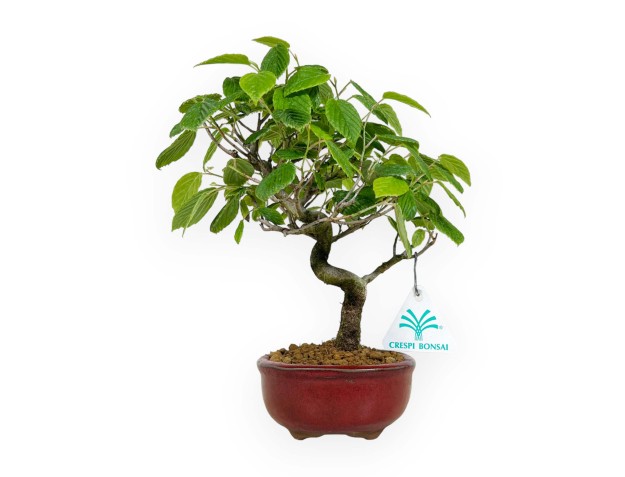
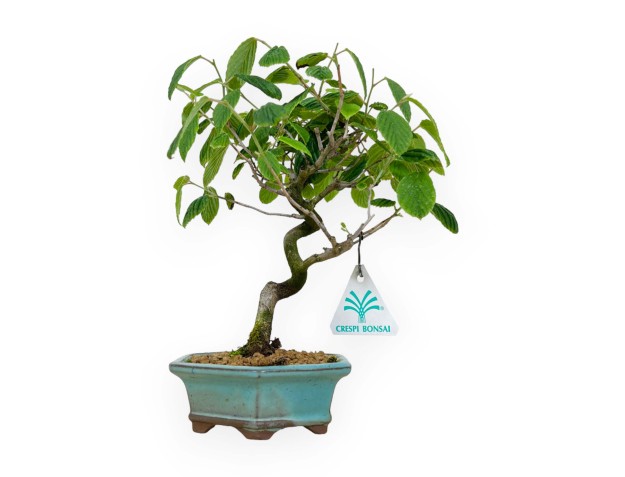
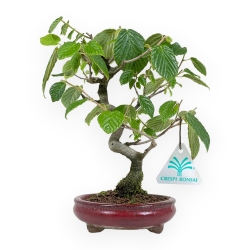
Corylopsis bonsai should only be grown outdoors, preferably in a bright spot but not in direct sunlight, especially during the hottest hours of the day. It adapts well to partial shade, provided it receives at least 3-4 hours of direct sunlight per day. Being a plant of mountainous and wooded origin, it loves cool, humid environments and suffers in overly dry or windy conditions. In summer, it should be protected from strong sun, while in winter it can withstand the cold, provided that the pot is sheltered from intense frosts or prolonged freezing temperatures, which can damage the flower buds that have already formed.
The common rule of watering whenever the soil feels dry to the touch is also ideal for Corylopsis, but bear in mind that in hotter periods and in strong winds, you will need to water more frequently. In fact, in these cases, the soil often risks becoming completely dry. It is also important to bear in mind that both a lack of water and excess water can cause serious damage to the plant. More specifically, a lack of water causes the leaves to wilt and stunted growth, while excess water causes the tips of the leaves to turn black.
Corylopsis bonsai should be repotted every 2-3 years, preferably in spring, immediately after flowering. Its root system is fine and shallow, so it is important not to prune the roots too drastically. It is advisable to remove a third of the roots and renew the substrate, which should be slightly acidic. After repotting, the plant should be kept in a protected, semi-shaded area for a few days to facilitate recovery.
The main pruning is done in spring, immediately after flowering. Branches that have flowered can be shortened, stimulating the plant to produce new vegetation for the following year. It is important to avoid overly drastic pruning, especially on old wood, from which Corylopsis does not always regrow well. During the summer, minor maintenance pruning can be carried out, but care must be taken not to remove the young flowering shoots, which begin to form in the fall. Larger cuts should be protected with healing mastic to prevent disease or drying out.
Pinching is carried out during the growing season, i.e. from late spring to early summer, when new shoots lengthen and begin to produce leaves. This is done by shortening overly vigorous shoots to 2-3 leaves, in order to contain growth and stimulate lateral branching. Pinching should be done regularly, but avoid removing shoots that are in the bud differentiation stage, which begin to form in the fall.
Corylopsis can be trained, but this should only be done on young, flexible branches, as they become brittle and difficult to shape with age. The ideal time to apply the wire is in early spring, immediately after flowering, when growth is active but the branches are not yet too woody. The wire should be applied gently to avoid damaging the thin bark. For more significant changes to the structure, it is advisable to use tie rods or to intervene gradually with targeted pruning.
Corylopsis should be fertilized moderately and regularly. Start after flowering, using a balanced fertilizer or one that is slightly richer in potassium. In summer, it is best to suspend fertilization and gradually reduce it in autumn, so as not to interfere with bud formation and to promote lignification. Avoid fertilizers that are too high in nitrogen, as these will stimulate excessive foliage growth at the expense of flowering. Balanced fertilization also promotes intense autumn leaf color.
Corylopsis is generally hardy, but can be sensitive to heat stress, dry winds, and water shortages. It is important to maintain a good balance between light, water, and ambient humidity. Among pests, it can occasionally be attacked by aphids or red spider mites, especially in hot, dry periods. Good air circulation and regular cleaning of the leaves help prevent problems. The buds are very delicate and should be protected from late frosts and sudden changes in temperature.
 English
  Italiano
 Deutsch
 Français
 Español
 Nederlands