Error!

Camellia

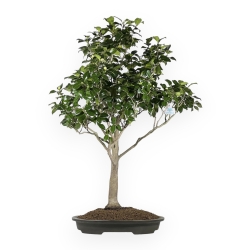
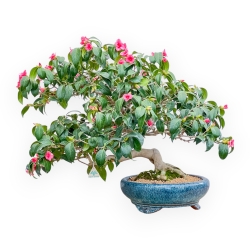
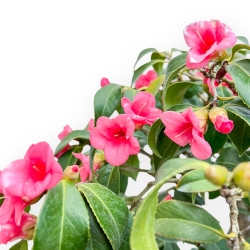
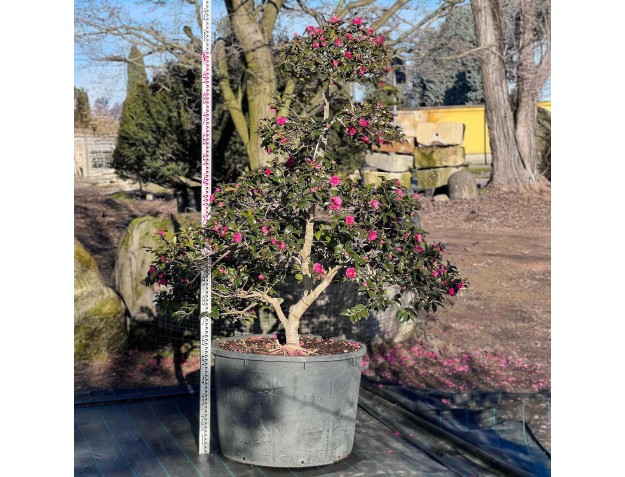
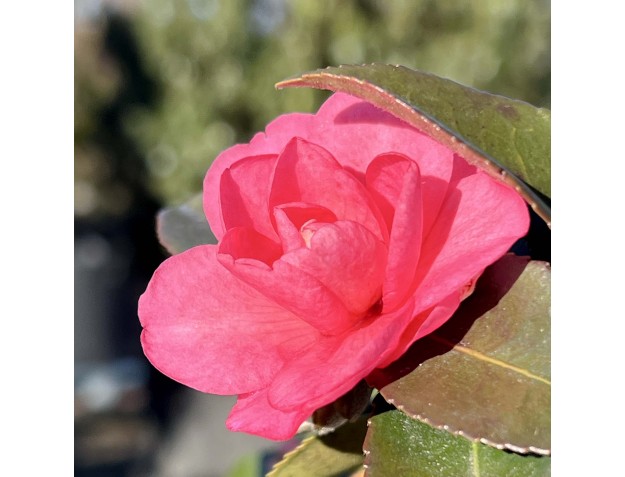
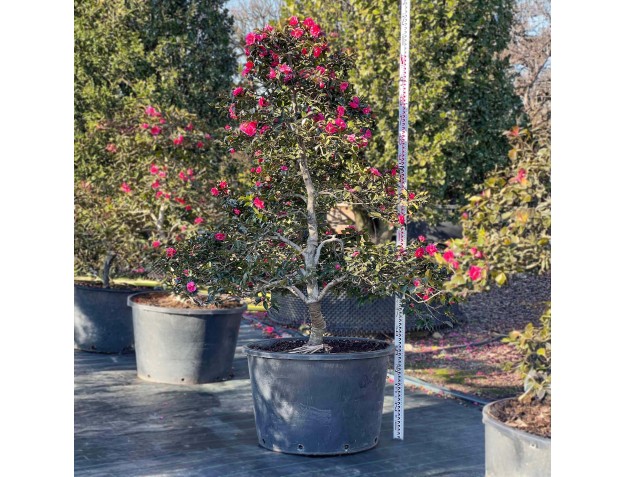
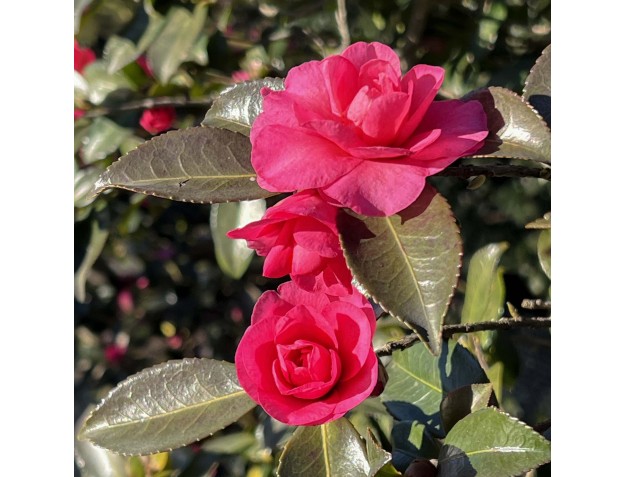
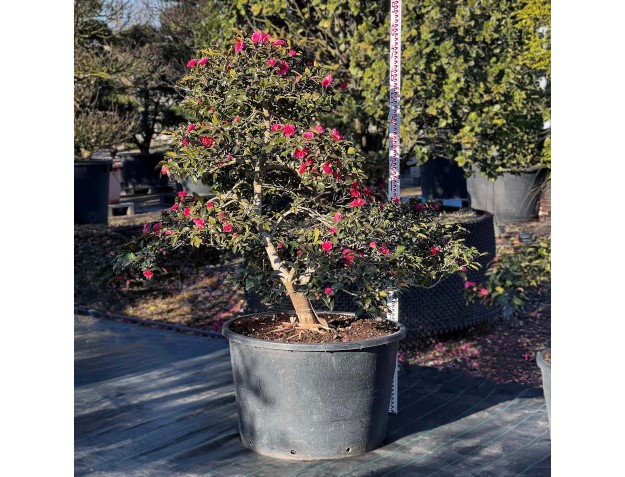
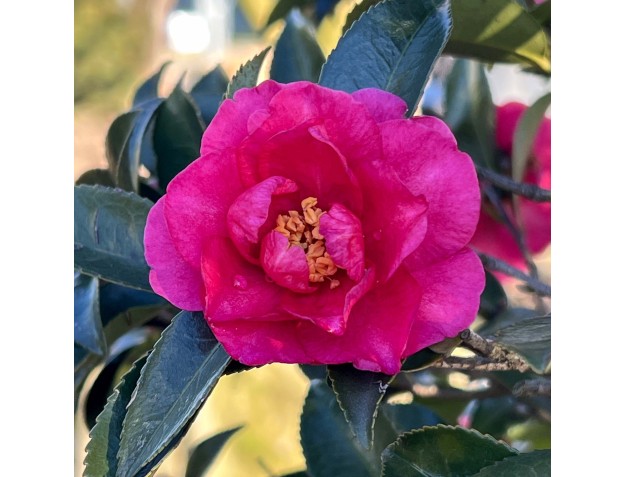
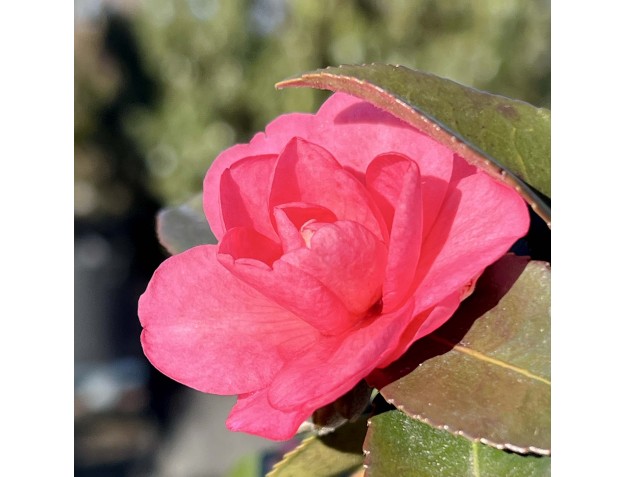
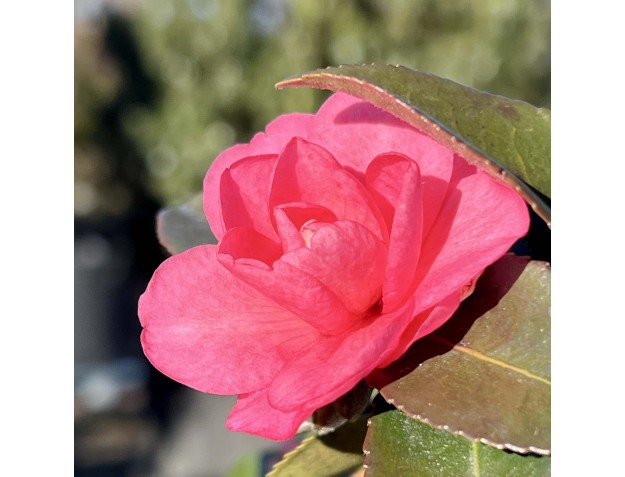
It is evident that the bonsai interest in this species is mainly related to its spectacular flowering. However, the other very important characteristics that Camellia possesses and that are appreciable in a bonsai should also be considered: the small leaf, the dense foliage and the short internodes. The reduced form also allows the character and peculiarities of each species to be appreciated more than in the wild. Among the most popular varieties is undoubtedly Camellia sasanqua, which is also the smallest and most compact. The styles it is best suited to are: formal upright, sloping, cascading, two-trunked and common stock, in medium and large sizes.

Camellias do not tolerate harsh climates, so in winter they need to be protected from the cold by placing them in a sheltered spot, while ensuring they remain in a cool, bright location with temperatures between 2°C and 12°C. From March to September, they can be placed outdoors in a well-ventilated spot, but sheltered from direct sunlight, especially between June and August.

The common rule of watering whenever the soil feels dry to the touch is also ideal for Camellia, but bear in mind that during hotter periods and in strong winds, you will need to water more frequently. As it is an evergreen species, it is essential to water it frequently even in winter, but avoid excessive moisture, which causes the leaves to turn yellow and fall off. When the buds are about to form, watering should be moderate. In summer, water abundantly, maintaining average humidity.

As this is a plant with good growth vigor, it is advisable to repot it fairly frequently, at least every 2-3 years. The ideal period is from mid-April to early June, when the base of the new shoots is mature and well established, i.e., when the shoot is still about half green, but the base has already taken on the typical color of wood. At this time, the white roots are developing vigorously, so transplanting can be done without any problems. When repotting, the young shoots should be shortened to 1-2 nodes, provided that there are new buds at the base. The ideal mixture consists of: 70% kanuma, 20% ready-made soil, and 10% sand.

The formation of Camellia, which grows vigorously, is achieved mainly through pruning. It is important to prune unnecessary branches that grow in inappropriate positions from after flowering until the end of June. The procedure consists of removing wilted flowers, including calyxes, at the end of flowering, shortening the branches to 1-2 nodes. It is worth bearing in mind that, as this is a species that flowers easily, in order to improve its appearance, it is advisable to thin out the flower buds to give them a more uniform distribution. Flower buds are slightly larger and rounder than leaf buds.

Pinching is an effective training technique, but in the case of young plants, it is best to allow the shoots to grow for a certain period of time in order to obtain enlargement before applying it. On mature specimens, however, pinching, which is practiced from April to mid-July, is an indispensable method for training the structure of the branches. The best way to do this is to let the green shoots grow to a length of 5-10 cm, then shorten them to 1-2 leaves using your fingers or tweezers. If you do this when the tip is still thick and compact, you will obtain branches with short internodes. Flower buds will subsequently form on the nodes left behind.

It is mainly applied to long branches, which should be wrapped and bent downwards. Bear in mind that the bark of the Camellia is very soft and even when using copper-coated aluminum wire instead of copper wire, there is a risk of marking it, so it is advisable to always cover the wire, for example, with adhesive tape. Due to its rapid growth, the wire cannot be left on the tree for too long: it is advisable to check the wrapping frequently, removing the wire as soon as it starts to cut into the bark.

At the end of flowering, after pruning, apply Bonsan Stimulating Fertilizer combined with Bonsan Liquid Organic Fertilizer 3 times every 8-10 days. During other periods, use Bonsan Hanagokoro Solid Organic Fertilizer every 15-25 days, excluding July and August. Twice a year (in autumn and at the end of winter), apply Bonsan Hanagokoro Solid Organic Fertilizer; 6-8 times a year, it is also advisable to use Bonsan Mineral Curative Solution. To stimulate rooting, use Bonsan Organic Mineral Liquid Fertilizer with B vitamins instead of Bonsan Organic Liquid Fertilizer.

As a bonsai, it has several points of interest, in particular its small size and thick canopy of small leaves, as well as its lush flowering.

Advice on:
Location

Camellias do not tolerate harsh climates, so in winter they need to be protected from the cold by placing them in a sheltered spot, while ensuring they remain in a cool, bright location with temperatures between 2°C and 12°C. From March to September, they can be placed outdoors in a well-ventilated spot, but sheltered from direct sunlight, especially between June and August.

Watering

The common rule of watering whenever the soil feels dry to the touch is also ideal for Camellia, but bear in mind that during hotter periods and in strong winds, you will need to water more frequently. As it is an evergreen species, it is essential to water it frequently even in winter, but avoid excessive moisture, which causes the leaves to turn yellow and fall off. When the buds are about to form, watering should be moderate. In summer, water abundantly, maintaining average humidity.

Repotting

As this is a plant with good growth vigor, it is advisable to repot it fairly frequently, at least every 2-3 years. The ideal period is from mid-April to early June, when the base of the new shoots is mature and well established, i.e., when the shoot is still about half green, but the base has already taken on the typical color of wood. At this time, the white roots are developing vigorously, so transplanting can be done without any problems. When repotting, the young shoots should be shortened to 1-2 nodes, provided that there are new buds at the base. The ideal mixture consists of: 70% kanuma, 20% ready-made soil, and 10% sand.

Pruning

The formation of Camellia, which grows vigorously, is achieved mainly through pruning. It is important to prune unnecessary branches that grow in inappropriate positions from after flowering until the end of June. The procedure consists of removing wilted flowers, including calyxes, at the end of flowering, shortening the branches to 1-2 nodes. It is worth bearing in mind that, as this is a species that flowers easily, in order to improve its appearance, it is advisable to thin out the flower buds to give them a more uniform distribution. Flower buds are slightly larger and rounder than leaf buds.

Pinching

Pinching is an effective training technique, but in the case of young plants, it is best to allow the shoots to grow for a certain period of time in order to obtain enlargement before applying it. On mature specimens, however, pinching, which is practiced from April to mid-July, is an indispensable method for training the structure of the branches. The best way to do this is to let the green shoots grow to a length of 5-10 cm, then shorten them to 1-2 leaves using your fingers or tweezers. If you do this when the tip is still thick and compact, you will obtain branches with short internodes. Flower buds will subsequently form on the nodes left behind.

Wiring

It is mainly applied to long branches, which should be wrapped and bent downwards. Bear in mind that the bark of the Camellia is very soft and even when using copper-coated aluminum wire instead of copper wire, there is a risk of marking it, so it is advisable to always cover the wire, for example, with adhesive tape. Due to its rapid growth, the wire cannot be left on the tree for too long: it is advisable to check the wrapping frequently, removing the wire as soon as it starts to cut into the bark.

Fertilization

At the end of flowering, after pruning, apply Bonsan Stimulating Fertilizer combined with Bonsan Liquid Organic Fertilizer 3 times every 8-10 days. During other periods, use Bonsan Hanagokoro Solid Organic Fertilizer every 15-25 days, excluding July and August. Twice a year (in autumn and at the end of winter), apply Bonsan Hanagokoro Solid Organic Fertilizer; 6-8 times a year, it is also advisable to use Bonsan Mineral Curative Solution. To stimulate rooting, use Bonsan Organic Mineral Liquid Fertilizer with B vitamins instead of Bonsan Organic Liquid Fertilizer.

Care

As a bonsai, it has several points of interest, in particular its small size and thick canopy of small leaves, as well as its lush flowering.

Filter by
Categories
Price
Style
Origin
Height
Filter
Flower Bonsai

Camellia - 57 cm

Camellia
Y09LLI-2660
€100.00
Bonsai are living beings and each one is different from the others, so the plant you'll receive will be similar but not the same as the one you see in the photo Appearance may change according to the seasons Heigh (without pot): 45 cm Trunk: 2 cm Pot: Ø 21 x 12 cm
Camellia - Camellia - 55 cm Camellia - Camellia - 55 cm 2
Available
Flower Bonsai

Camellia - Camellia - 55 cm

Camellia
Y09ANE-4945
€268.18
Appearance may change according to the seasons Height without pot: 45 cm Width trunk: 2,5 cm Pot: 25,5 x 20,5 x H 10 cm
Camellia Tsubaki - Camellia - 110 cm Camellia Tsubaki - Camellia - 110 cm 2
Available
Masterpiece Bonsai

Camellia Tsubaki - Camellia - 110 cm

Camellia
Y09LTOI-4917
€1,527.27
Unique specimen Appearance may change according to the seasons Height with pot: 103 cm Nebari: 14 cm Width trunk: 4,5 cm Pot: 47 x 37 x H 7 cm
Camellia - Camelia - 56 cm Camellia - Camelia - 56 cm 2
Available
Flower Bonsai

Camellia - Camelia - 56 cm

Camellia
Y09ANE-6067
€268.18
Appearance may change according to the seasons Style: broom Height without pot: 46 cm Trunk: 2,5 cm Glazed stoneware pot: 26 x 21 x H 10 cm
Camellia - Camelia - 70 cm Camellia - Camelia - 70 cm 2
Available
Flower Bonsai

Camellia - Camelia - 70 cm

Camellia
Y09MNE-6323
€359.09
Appearance may change according to the seasons Height without pot: 59,5 cm Trunk: 4 cm Nebari: 10 cm Unglazed stoneware pot: 30,5 x 23 x H 10,5 cm
Camellia bonsai, 53 cm | Blue round pot Camellia bonsai, 53 cm | Blue round pot 2
Available
Flower Bonsai

Camellia - Camellia - 53 cm

Camellia
Y09LLI-7000
€100.00
Camellia bonsai characterized by a height without pot of 41 cm, and trunk size of 2,5 cm. The plant is grown in a round glazed stoneware pot whose dimensions are Ø21xH12 cm.
Camellia - Camelia - 61 cm Camellia - Camelia - 61 cm 2
Available
Flower Bonsai

Camellia - Camelia - 61 cm

Camellia
Y09ANE-6071
€268.18
Appearance may change according to the seasons Style: broom Height without pot: 51 cm Trunk: 3,5 cm Nebari: 13 cm Glazed stoneware pot: 27 x 22 x H 10 cm
Camellia - Camellia - 63 cm Camellia - Camellia - 63 cm 2
Available
Flower Bonsai

Camellia - Camellia - 63 cm

Camellia
Y09ANE-4944
€268.18
Appearance may change according to the seasons Height without pot: 53 cm Width trunk: 2,5 cm Pot: 27 x 21 x H 10 cm
Flower Bonsai

Camellia - 55 cm

Camellia
Y09LTE-4192
€150.00
Bonsai are living beings and each one is different from the others, so the plant you'll receive will be similar but not the same as the one you see in the photo Appearance may change according to the seasons Height without pot: 40 cm Trunk: 2,5 cm Pot: Ø 24,5 x 15 cm
Camellia bonsai 50 cm | Blue oval pot Camellia bonsai 50 cm | Blue oval pot 2
Available
Flower Bonsai

Camellia japonica - Camellia - 50 cm

Camellia
Y09LTE-7005
€150.00
Camellia bonsai characterized by a height without pot of 42,5 cm, and trunk size of 2 cm. The plant is grown in an oval glazed stoneware pot whose dimensions are 26x21xH7,5 cm.
Camellia - Camellia - 60 cm Camellia - Camellia - 60 cm 2
Available
Flower Bonsai

Camellia - Camellia - 60 cm

Camellia
Y09APOI-4954
€2,254.55
Appearance may change according to the seasons Unique specimen Style: semi cascade Height without pot: 49 cm Trunk: 4 cm Nebari: 17 cm Glazed stoneware pot: Ø 32 x H 11 cm
Camellia bonsai 60 cm | Blue oval pot Camellia bonsai 60 cm | Blue oval pot 2
Available
Flower Bonsai

Camellia japonica - Camellia - 60 cm

Camellia
Y09LTE-7004
€150.00
Camellia bonsai characterized by a height without pot of 52,5 cm, and trunk size of 2 cm. The plant is grown in an oval glazed stoneware pot whose dimensions are 26x21xH7,5 cm.
Camellia - Camelia - 56 cm Camellia - Camelia - 56 cm 2
Available
Flower Bonsai

Camellia - Camelia - 56 cm

Camellia
Y09ANE-6072
€268.18
Appearance may change according to the seasons Style: broom Height without pot: 46 cm Trunk: 2,5 cm Nebari: 7 cm Glazed stoneware pot: 26 x 21 x H 10 cm
Flower Bonsai

Camellia - Camelia - from 39 to 43 cm

Camellia
Y09TE-6065
€59.09
Appearance may change according to the seasons Bonsai are living beings and each one is different from the others, so the plant you'll receive will be similar but not the same as the one you see in the photo Height without pot: from 29,5 to 34 cm - may vary with the vegetative growth of the plant Trunk: 1,5 - 2 cm Glazed stoneware pot: Ø 15 x H 9 cm
Camellia bonsai 40 cm | Blue rectangular pot Camellia bonsai 40 cm | Blue rectangular pot 2
Available
Flower Bonsai

Camellia japonica - Camellia - 40 cm

Camellia
Y09LME-7003
€122.73
Camellia bonsai characterized by a height without pot of 33 cm, and trunk size of 1,5 cm. The plant is grown in a rectangular pot with rounded corners in glazed stoneware whose dimensions are 16x13,5xH7 cm.
Flower Bonsai

Camellia - Camelia - from 61 to 65 cm

Camellia
Y09LLI-6066
€100.00
Appearance may change according to the seasons Bonsai are living beings and each one is different from the others, so the plant you'll receive will be similar but not the same as the one you see in the photo Height without pot: from 48,5 to 52,5 cm - may vary with the vegetative growth of the plant Trunk: 2 - 2,5 cm Glazed stoneware pot: Ø 21 x H 12,5 cm
Camellia bonsai 32 cm | Blue rectangular pot Camellia bonsai 32 cm | Blue rectangular pot 2
Available
Flower Bonsai

Camellia japonica - Camellia - 32 cm

Camellia
Y09LME-7002
€122.73
Camellia bonsai characterized by a height without pot of 25 cm, and trunk size of 1,5 cm. The plant is grown in a rectangular pot with rounded corners in glazed stoneware whose dimensions are 16x13,5xH7 cm.
Product added to wishlist